
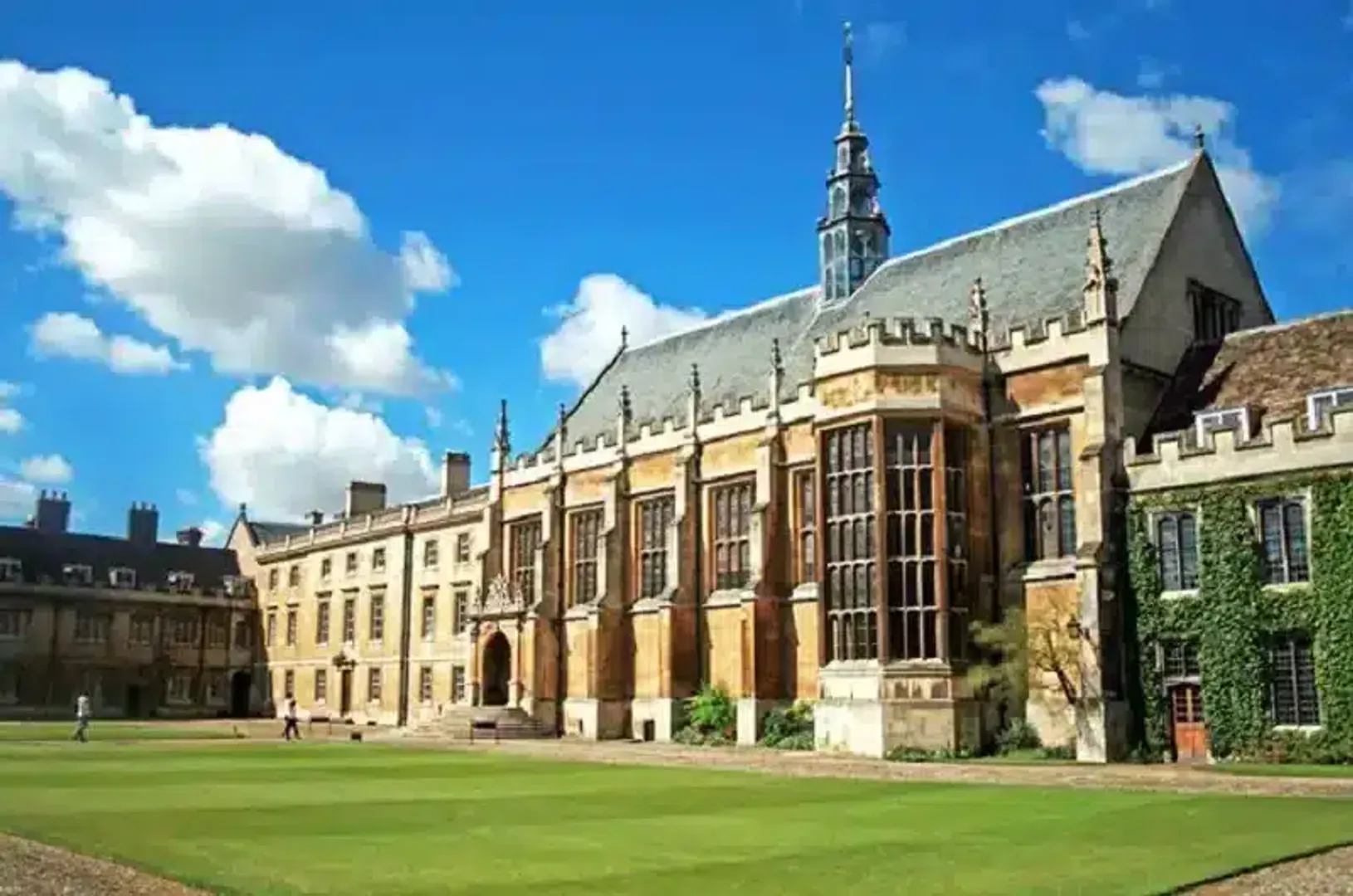

King’s College and King’s College Chapel
Founded in 1441 by Henry VI and the earliest of the royal foundations, King’s College is worth visiting for the huge expanse of lawn extending down to the river and King’s Bridge. Here, you’ll enjoy lovely views of the Backs, the various college grounds along the riverside. Distinguished alumni include writer Horace Walpole, poet Rupert Brooke, and economist Lord Keynes.
A must-see here is King’s College Chapel, renowned for its 12-bay perpendicular-style interior and breathtaking fan vaulting by John Wastell (1515). Also worth checking out: the tracery on the windows and walls, the 16th-century stained-glass windows, the carved wooden organ screen and choir stalls, and the altarpiece, Rubens’ Adoration of the Magi (1634).

Queens’ College and the Mathematical Bridge
Founded in 1448 by Andrew Dockett under the patronage of Margaret of Anjou, and refounded in 1465 by Elizabeth Woodville, Queens’ College has the most complete medieval buildings of all Cambridge’s colleges, including the gateway leading to the red brick First Court.
Other sites to visit include the wooden Mathematical Bridge — a 1902 reconstruction built without nails — Cloister Court with the President’s Lodge, Pump Court with the Erasmus Tower, Walnut Tree Court (1618), and Friars Court with its Victorian chapel (1891).

Cambridge University Botanic Garden
Covering some 40 acres and established in 1831, this garden showcases more than 8,000 plant species from across the globe, making it a must-do for gardening enthusiasts.
Wander the many glasshouses and trails, join a guided tour (free on Sundays), then visit the Garden Café and shop. Check the website for upcoming events and festivals.

Great St. Mary’s Church and the Round Church
Great St. Mary’s, both a parish and university church, was built in the 15th century, with galleries added in 1739 and a tower from 1608 offering fine views over Cambridge.
Also nearby: Little St. Mary’s, known for its stained glass; the Round Church (Church of the Holy Sepulchre), one of only four Norman round churches in England, built in 1131; and the Gothic Revival Church of Our Lady and the English Martyrs (1885).

Trinity College
Established in 1546 by Henry VIII from the merger of older colleges including Michaelhouse and King’s Hall, Trinity’s Great Court, laid out around 1600, is the largest court in Cambridge. Nevile’s Court (1614) and Wren’s Library, designed by Sir Christopher Wren, follow.
Trinity counts more distinguished alumni than any other college, including Nehru, Bertrand Russell, and Isaac Newton. From New Court, cross the bridge over the Cam for a fine view of the Backs and the avenue of limes leading to the College Grounds.

The Fitzwilliam Museum
Cambridge’s most famous museum, the Fitzwilliam holds a magnificent collection of English pottery and china, plus Greek, Roman, and Egyptian antiquities and illuminated manuscripts.
Its gallery features Hogarth, Gainsborough, and Turner, alongside Impressionists and Dutch Baroque masters such as Rembrandt, Van Dyck, and Rubens. A café and gift shop are also on-site.

Anglesey Abbey, Gardens and Lode Mill
Built in the 12th century and refurbished in 1926, Anglesey Abbey is now a National Trust property known for its fine art and furnishings, including tapestries and Constable’s The Opening of Waterloo Bridge.
Enjoy 114 acres of surrounding parkland, the Wildlife Discovery Area, the Lime Tree Lookout, and the historic Lode Mill, where the grindstones still turn. Check the website for special events.

Museum of Archaeology and Anthropology
Developed by Cambridge University in 1884, this museum holds an important collection of prehistoric material and social anthropology artifacts gathered from around the world, with a notable Pacific collection from Cook’s explorations.
Nearby, visit the Sedgwick Museum of Earth Sciences, home to roughly two million minerals, rocks, and fossils including meteorites and Darwin’s Beagle Collection, and the recently renovated University Museum of Zoology.

Peterhouse College
The oldest and one of the smallest of Cambridge’s colleges, Peterhouse was founded in 1284. Its historic hall and storeroom on Old Court’s south side are among the earliest surviving 13th-century buildings. Alumni include Cardinal Beaufort and chemist Henry Cavendish.
Don’t miss Peterhouse Chapel, with stained-glass windows imported from Munich in the 1850s and a 17th-century altar window. Summer accommodation rentals are also available.

Corpus Christi College
Founded in 1352 “by the townspeople for the townspeople,” Corpus Christi’s oldest section, Old Court, dates back to 1377. Its library holds valuable manuscripts collected by Archbishop Matthew Parker (1550).
The adjoining St. Benet’s Church was the original college chapel. Alumni include dramatists Christopher Marlowe and John Fletcher, and the college offers summer accommodations popular for events like weddings.